Battery passport: the complete overview
From 18 February 2027 every LMT battery, every industrial battery above 2 kWh and every EV battery placed on the market or put into service in the EU needs a digital battery passport. That is Article 77 of Regulation (EU) 2023/1542. This page gives the overview: what the passport is and who the duty hits. Plus the data, the QR labeling, the state of the EU registry and the most common mistakes.

What is the battery passport?
The battery passport is a digital record that identifies an individual battery and documents its key properties: from the manufacturer's identification through performance and durability values to information for dismantling and recycling. It is accessed via a QR code on the battery that leads to an electronic view of the passport. Legally, the battery passport is anchored in Chapter IX of the Battery Regulation, which consists of Articles 77 and 78. Which data belongs in the passport and who may see it is governed by Annex XIII of the regulation.
The battery passport is also the EU's first mandatory digital product passport (DPP). The Ecodesign Regulation ESPR will later extend digital product passports to further product groups, but the battery passport follows its own rules from the Battery Regulation. This is more than a formality: Decision (EU) 2026/1736 has harmonised six DPP standards, but the associated presumption of conformity applies only to ESPR product passports and not to the battery passport. Using these standards remains voluntary.
For practical implementation there is still solid orientation. DIN SPEC 99100 describes, as a guideline, a data structure for the battery passport in seven categories. For the technical interface, EN 18222 is a dedicated API standard; its DIN version, DIN EN 18222:2026-09, has been published.
If you are right at the start, read what is a battery passport? first.
What the passport is for
The duty is one thing, the purpose another. Recital 123 of the regulation names it expressly. The passport is introduced “to increase transparency along the supply and value chains for all stakeholders”. It should ensure “maximises the exchange of information” and “allows tracking and tracing of batteries”. Four groups benefit from it. For manufacturers the view is worth it, because it shows which figure is needed for what.
- The public is to receive information about batteries placed on the market and their sustainability requirements. That is the public block every QR scan reveals.
- Reusers, second-life operators and recyclers need current data for handling. On top come tailored details such as the state of health. That is the level for persons with a legitimate interest.
- Buyers of a used battery should be able to judge residual value and remaining lifetime. The same goes for third parties acting on their behalf. Article 14(2) names exactly this purpose. It grants read access to the parameters in Annex VII.
- For market surveillance authorities the passport should make the work easier. It does not replace or change their competences.
In practice: the passport is not a form for the authority. It is a data source for four different sets of readers. Knowing who needs a figure later leads to better decisions while filling it in. That applies to how precisely the composition is described, for example.
Who is affected?
The passport obligation of Article 77 covers exactly three battery categories:
- LMT batteries, i.e. batteries for light means of transport such as e-bikes and e-scooters,
- industrial batteries with a capacity above 2 kWh, which in the regulation's system also includes stationary energy storage,
- EV batteries, i.e. traction batteries for electric vehicles.
What counts is the placing on the EU market or putting into service from 18 February 2027. Where the battery was manufactured does not matter: responsible for the passport is the economic operator who places the battery on the EU market. This applies to manufacturers based in the EU as well as importers bringing batteries or battery-powered products in from third countries. For other batteries, such as classic portable batteries, Article 77 does not provide for a passport obligation.
Also important: the passport applies per battery, not per model. Every single battery placed on the market or put into service needs its own passport with its own identifier, reachable via that battery's QR code. This makes the battery passport a task for your series production processes, not just for the documentation department.
Details on deadlines and who is affected are in the guide battery passport duty.
The deadline: 18 February 2027, and what to do until then
18 February 2027 triggers several obligations at once. From that day on, affected batteries must have a battery passport when placed on the market or put into service, carry the QR code and be registered in the EU registry. By the same date, the member states must have designated their national registry administrators.
These steps can realistically be completed by the deadline:
- Clarify whether you are affected. Check per product line whether your batteries count as LMT batteries, EV batteries or industrial batteries above 2 kWh, and who in your supply chain is the economic operator placing them on the market.
- Take stock of your data points. Map your existing data against Annex XIII. The Commission's non-binding guidance “data points by category” of 15 August 2026 (version 2.0) lists 71 data points with their mandatory status per battery category and their legal basis, usually a provision of Annex XIII, and is the best working basis for this.
- Involve your supply chain. Many values, such as recycled content shares, come from suppliers. Clarify early who delivers which values and in which format.
- Plan your identifiers. The passport needs a unique identifier that works as a link. For the EU registry this identifier has to be in a URL format under JTC 24. It may not exceed 2000 characters.
- Bring the QR process into production. The QR code must lead permanently to the correct passport. It goes on the battery or, where nature and size do not allow or warrant this, on the packaging and accompanying documents. This concerns printing, application and the stability of the linked address.
- Prepare the registry verification. Only a verified economic operator may register. Verification currently runs through a qualified electronic seal or a qualified electronic signature under eIDAS and is valid for at most three years. Plan lead time for this.
- Watch the open legal acts. Implementing acts are still missing for the carbon footprint and for access via legitimate interest. Anyone building here today is building on assumptions and should budget for changes.
You will find a detailed step-by-step list in the Battery passport checklist 2027, and a practical guide to your first passport in Create a battery passport: guide.
Data scope: Annex XIII explained
Annex XIII of the Battery Regulation defines which data belongs in the battery passport. Who may see which entries is governed by Article 77(2). There are three access tiers.
Public data
This part of the passport is visible to anyone who scans the QR code: no login, no cost. Which data points are public is listed point by point in Annex XIII point 1; the Commission's non-binding guidance states the legal basis, usually a provision of Annex XIII, and the mandatory status for each of the 71 data points.
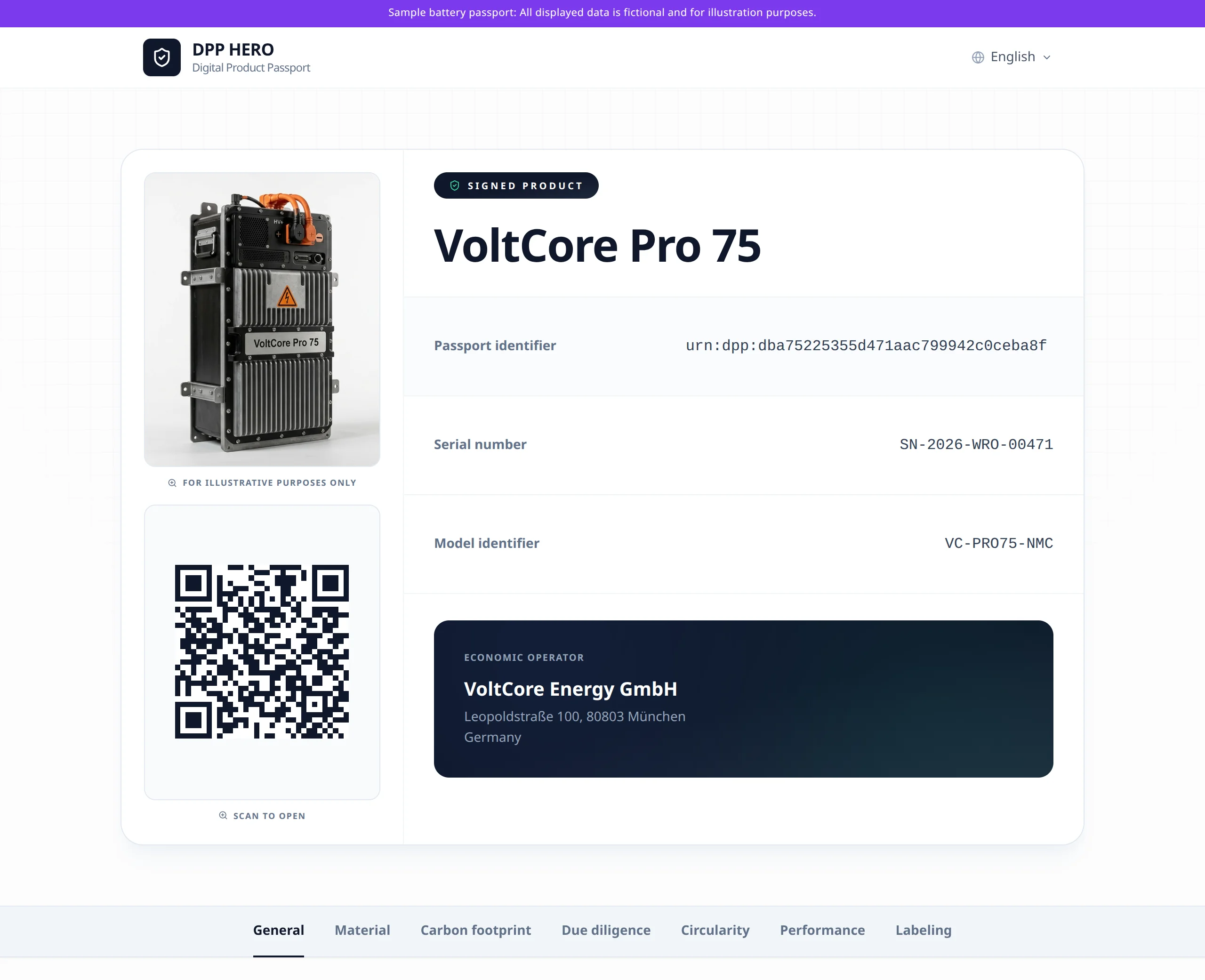
Data for persons with a legitimate interest
Annex XIII points 2 and 4 are accessible to persons with a legitimate interest (Article 77(2)(c)). Point 2 includes the detailed composition and dismantling information, point 4 the data on the individual battery. Who counts as a person with a legitimate interest, and which information they may use to what extent, is to be set out in an implementing act under Article 77(9). Its deadline was 18 August 2026; it has not been adopted yet.
Data for notified bodies, market surveillance and the Commission
Points 2 and 3 are accessible to notified bodies, market surveillance authorities and the Commission (Article 77(2)(b)). Point 3 holds exactly one thing, the results of the test reports, and only these bodies see it.
This is how DPP Hero implements it: our field registry holds 128 fields across all battery categories, and each carries a fixed access level. 82 fields are public. 28 fields are not public and only visible to persons with a legitimate interest, for model data also to notified bodies, market surveillance authorities and the Commission. 5 fields are only visible to notified bodies, market surveillance authorities and the Commission. A further 13 fields are visible only to your own team.
Data that grows with the battery
A second distinction runs across the access levels. Annex XIII point 4 holds data on the individual battery that changes over its life. That covers performance and durability values at placing on the market and at every change of status, the state of health under Article 14 and the status in five stages: original, repurposed, reused, remanufactured or waste. Added to those are the data from use such as charging cycles, negative events, operating temperature and state of charge. For state of health and expected lifetime, Annex VII names the parameters in detail. Since 18 August 2024 the battery management system must keep them current under Article 14(1). The remaining entries, accidents or state of charge for example, are not in Annex VII. They belong in the passport, not necessarily in the battery management system.
These entries belong to the second level. They are not public but reserved for persons with a legitimate interest. Under Article 77(4) the economic operator placing the battery on the market must keep them current. They may authorize others in writing, the responsibility stays with them. How that works in practice is in the guide battery passport software.
Three particularities are worth knowing. First, the Commission's non-binding guidance of 15 August 2026 (version 2.0) explicitly defers some data points (“Not to be filled/displayed as of February 2027”): the carbon footprint declaration and label, until the implementing act on the format is in place, and the responsible sourcing information, which it requires only from 18 August 2027. Second, the recycled content shares for cobalt, lithium, nickel and lead also stay empty at the start; they follow Article 8 and its delegated act. Third, material composition (data point 16) and rated capacity (data point 25) stay empty because the same data is already required under other data points.
On the carbon footprint in plain terms: the CO2 obligations of the Battery Regulation are not triggered as of today. The fixed dates named in the law have passed, but the start depends on the methodology act and the format act, and both are missing. There is currently no applicable CO2 declaration obligation for the battery passport.
QR code: the marking on the battery
Access to the battery passport runs through a QR code. It is printed or engraved visibly, legibly and indelibly on the battery; where the nature and size of the battery do not allow or warrant this, it goes on the packaging and the accompanying documents. This is required by Article 13(6) and (7), Article 77(3) and Annex VI Part C of the regulation, likewise from 18 February 2027. The code must lead to the passport of exactly that battery.
In practice that means two things. First, the QR code belongs in your production process, because every single battery gets its own code, as a rule directly on the battery. Second, the address behind the code has to stay stable across the lifetime. A passport whose link dies after a website rebuild misses the point. Plan the URL structure for the long run. For the registry the UPI rule applies: URL format, at most 2000 characters.
The EU registry for battery passports
Alongside the passport itself, the EU requires registration in a central Commission registry.
Implementing Regulation (EU) 2026/1778 has been in force since 6 August 2026. It describes the registry as a directory: stored are identifiers, commodity code and a hash, not the passport contents themselves. The regulation contains no technical schemas.
Battery passports cannot be registered there yet because the semantic catalogue for batteries is missing. We track the current status, with deadlines and sources, on the page What the EU still has to deliver.
For registration itself: only a verified economic operator may register. Verification currently runs through a qualified seal or a qualified signature under eIDAS and is valid for at most three years. Third parties may register on an operator's behalf if they are verified themselves; nobody can take over the economic operator's own verification. A DPP service provider, by the way, is not a defined actor under the Battery Regulation: an official list or recognition procedure for providers does not exist.
From 18 February 2027, registration becomes mandatory: affected batteries must be registered when placed on the market or put into service.
How the registry works in detail is covered in the guide EU battery passport registry.
The key deadlines
- 15 July 2026The EU officially recognizes six standards for the digital product passport, among them EN 18222 for the interfaces. The presumption of conformity applies only to ESPR product passports, not to the battery passport. There, use stays voluntary (Decision (EU) 2026/1736).
- 17 July 2026Publication in the Official Journal: Implementing Regulation (EU) 2026/1778 sets out the structure and registration process of the central DPP registry. It enters into force only on 6 August 2026.
- 20 July 2026The EU Commission's central DPP registry is live, including a test environment for companies (ESPR Art. 13(1)).
- 6 August 2026Implementing Regulation (EU) 2026/1778 enters into force. Its rules for verification and registration apply from now on.
- 13 August 2026The end-of-life vehicles regulation (EU) 2026/1738 replaces Annex I of the Battery Regulation. It brings stricter limits for cadmium, lead and newly chromium(VI) in batteries for cars and light commercial vehicles. That is a design requirement, not a passport field. In the passport, Annex XIII point 1(b) exempts mercury, cadmium and lead only from the list of hazardous substances; the labeling under Article 13(4) and (5), such as the symbol for cadmium or lead, still belongs in it under point (q).
- 18 August 2026Deadlines for several acts passed, among them Article 77(9) (access rights) and Article 8(1) (recycled content). What has been delivered since is shown on the page What the EU still has to deliver.
- September 2026Published: DIN EN 18222:2026-09, the DIN version of the API standard. On 16 September 2026 CEN also published EN 18239 and EN 18246.
- 18 February 2027Passport duty, QR duty and registration duty take effect. Covered are LMT batteries, industrial batteries above 2 kWh and EV batteries. By then the member states must have named their national registry administrators.
- 18 August 2027The supply chain due diligence obligations (Art. 48) apply, postponed by Regulation (EU) 2025/1561.
- 18 February 2029Deadline for the CO2 act on industrial batteries with external storage.
- No date yetFor the semantic catalogue for battery passports in the EU registry, the Commission gives no date. The implementing act on legitimate interest (Article 77(9)) and an act on requirements for DPP service providers also have no fixed date. The planning is on the page What the EU still has to deliver.
The second life: repurposing, reuse and the new passport
A battery rarely ends where it was sold. A vehicle pack becomes a home storage unit, a faulty module becomes a remanufactured one. The Regulation knows these routes, names them individually and attaches the passport to them.
- Article 3 distinguishes four operations. Point 29 is preparing for re-use, point 30 preparing for repurposing. Point 31 is repurposing itself, point 32 remanufacturing. Repurposing means: the battery is not waste, but is used for a purpose other than the one it was designed for.
- Article 77(7) draws the consequence. It covers batteries prepared for re-use or repurposing, repurposed or remanufactured. For them responsibility passes on. It rests with the economic operator who placed the battery on the market. These batteries need a new passport, linked to that of the original battery.
- The status sits in the passport itself. Annex XIII point 4(c) requires the entry “original”, “repurposed”, “reused”, “remanufactured” or “waste”. Once the battery becomes waste, responsibility passes on. It then rests with the producer, the producer responsibility organisation or the selected waste operator.
- At the end comes deletion. Under Article 77(8) the battery passport is deleted once the battery has been recycled.
For residual value, Article 14(2) is the decisive lever. Anyone who has lawfully acquired a battery gets read access through the battery management system to the parameters in Annex VII, among other things to assess residual value, remaining lifetime and the scope for further use. This duty has applied since 18 August 2024 and covers stationary battery energy storage systems, LMT batteries and electric vehicle batteries.
In practice: do not plan the passport as a one-off handover on the day of sale. Plan it as a record that survives a change of status. It has to connect for the next operator.
What the passport delivers beyond the obligation
The compulsory part is not in dispute. Less discussed is that the same data set answers questions companies already have.
- After-sales and service: the QR code leads to a unique identifier of the individual unit. Seeing version, build state and safety notes at once saves queries and wrong parts.
- A direct line to the end customer: the scan lands on your passport page. Not at a dealer, not at a portal. It is the only channel in the chain that belongs to you.
- Evidence instead of claims: recycled content, carbon footprint and responsible sourcing sit in the public block. Documented properly, you point to a source in a purchasing meeting instead of a brochure.
- Second-hand market: only sight of state of health and usage history makes residual value and further use assessable.
Soberly put: these effects do not arrive on their own. They need maintained data. The passport is a shop window, and an empty one looks worse than none.
What sits alongside the Regulation
Guidance documents, standards and technical models have grown around the battery passport. They help with interpretation but do not replace the text of the Regulation.
- The Battery Pass consortium spelled out the fields from Annex XIII, funded by the German Federal Ministry for Economic Affairs and Energy. The Content Guidance last appeared in December 2023, a Technical Guidance in 2024, plus a software demonstrator. DIN SPEC 99100 emerged from it in January 2025. The project ended in March 2025.
- The administration shell under IEC 63278-1:2023 comes from the Industry 4.0 world. In English it is the Asset Administration Shell. It is discussed as a technical carrier for product data. The standard describes it as a standardized digital representation of an asset. In everyday terms that is the digital twin. It is not mandated anywhere.
- Industry data spaces such as Catena-X, the data space of Catena-X Automotive Network e. V. with the open reference building blocks of the Eclipse project Tractus-X, organise exchange between companies. A company already connected there will want to carry the passport there too; it is not a precondition for the passport obligation.
The yardstick stays Article 77(5): open standards, an interoperable format, transferable without vendor lock-in. On top: machine-readable, structured and searchable. Measuring against that avoids betting on one ecosystem.
Common mistakes in preparation
- Misjudging the CO2 obligation. The carbon footprint declaration is often presented as a duty in force. In fact the carbon duties are not triggered, for lack of a methodology and format act. The Commission's non-binding guidance classes carbon declaration, carbon label and responsible sourcing as not to be filled for February 2027.
- Trusting a seal or certificate. There is no official certification system for battery passport software or DPP service providers, and no GEFEG or BatteryPass seal either. Read advertising claims with seals accordingly critically and check concrete evidence instead, such as schema validation of the exports.
- Overestimating harmonised standards. Decision (EU) 2026/1736 harmonises six DPP standards, but the presumption of conformity applies only to ESPR product passports. For the battery passport it has no legal effect.
- Promising fixed registry dates. Battery passports cannot be registered in the EU registry yet, because the semantic catalogue is missing; the Commission's user guide gives no date. Plan the connection. But do not tie internal promises to EU building blocks that do not exist yet.
- Underestimating identifiers and verification. The UPI requirement with URL format and at most 2000 characters, the eIDAS verification valid for at most three years, and the question of who in your supply chain is the registering economic operator: all of this needs lead time and is not something for the last weeks before the deadline.
- Ignoring the access tiers. Publishing all passport data unfiltered misses the logic of Annex XIII, and holding everything back does too. The separation into public data, data for persons with a legitimate interest and data for notified bodies, market surveillance and the Commission belongs in the data model from the start.
- Waiting for full legal certainty before collecting data. Individual points still depend on implementing acts, but the large majority of the 71 data points is settled. Anyone who only starts collecting supplier data in 2027 has hardly any buffer left for coordination.
What implementation can cost and which items to budget for is covered in the guide Battery passport costs.
About this page
This page is run by DPP Hero, a self-service software for battery passports. It captures data precisely per battery type (EV, LMT, industrial, stationary storage, batteries without BMS), validates JSON exports against the schemas of the Battery Passport Data Model v2.0 with blocking checks, and publishes passports as a public page with QR code. If you would like to try it: prices are on the pricing page. We track new developments as they happen in the blog.
Frequently asked questions
From when is the battery passport mandatory?
From 18 February 2027 for LMT batteries, industrial batteries above 2 kWh and EV batteries placed on the EU market or put into service from that date. The legal basis is Article 77 of Regulation (EU) 2023/1542.
Does the obligation also apply to imported batteries?
Yes. What matters is the placing on the EU market or putting into service, not the place of manufacture. Responsible is the economic operator who places the battery on the market, which for imports is regularly the importer.
Does the carbon footprint already have to be in the passport?
No. The CO2 obligations are not triggered because the methodology and format acts are missing. The Commission's non-binding guidance explicitly classifies the CO2 declaration and the CO2 label as not to be filled for February 2027.
Is the battery passport already a digital product passport?
The battery passport is the first mandatory digital product passport and comes from the Battery Regulation, Chapter IX with Articles 77 and 78. The ESPR later extends the DPP principle to further product groups. The harmonised DPP standards from Decision (EU) 2026/1736 only take effect for ESPR passports.
Can I already register my battery passport in the EU registry today?
No. Battery DPP registration is blocked on the EU side because the semantic catalogue is missing. The sandbox has been reachable since 20 July 2026; the Commission's user guide gives no date for the catalog.
Who may register in the EU registry?
Only a verified economic operator. The proof is currently a qualified seal or a qualified signature under eIDAS, valid for at most three years. Third parties may register on an operator's behalf if they are verified themselves; the operator's own verification stays with the operator.
Which data in the passport is public?
Public is Annex XIII point 1: anyone who scans the QR code sees it. Points 2 and 3 are accessible to notified bodies, market surveillance authorities and the Commission, points 2 and 4 to persons with a legitimate interest (Article 77(2)). For each of the 71 data points, the Commission's non-binding guidance states the legal basis, usually a provision of Annex XIII.
Is there an official seal or certification for battery passport software?
No. There is neither a GEFEG or BatteryPass seal nor a certification system for DPP service providers. Requirements for DPP service providers are to be set by a delegated act under the Ecodesign Regulation; it does not exist yet, and there is no legal deadline for it.
What is the Global Battery Alliance battery passport?
A voluntary sustainability scheme, not the EU battery passport. The Global Battery Alliance is building its own certification system. It is due to start in 2027 and aligns with the EU Battery Regulation without replacing it. Finished are the GBA Battery Benchmarks with ESG criteria for 18 topic areas and the Greenhouse Gas Rulebook in version 2.1. The Scoring Rulebook and the Data Assurance Rulebook were still in development in 2026. To meet the duty, follow Annex XIII. To add an ESG signal, the GBA building blocks are worth a look.
What happens if the battery passport is missing or wrong?
The market surveillance authorities of the member states are in charge. Article 93 obliges the states to lay down sanctions: effective, proportionate and dissuasive. In Germany the frame is section 60 BattDG. Failing to ensure under Article 77(4) that the data is correct, complete and current costs up to ten thousand euros. Missing registration under Article 55 costs up to one hundred thousand euros. On formal non-compliance the authority first requires the fault to be put right, under Article 83. If it persists, the battery can be restricted, prohibited or withdrawn from the market.
Articles and fundamentals
The most important blog articles, fact-based and up to date.
What is a battery passport?
Definition, data categories and legal framework in the complete guide.
Battery passport: when is it mandatory?
Categories, deadlines and the concept of placing on the market.
Checklist: ready for 2027 in 10 steps
From data audit to pilot run, with a realistic timeline.
EU battery passport registry
Obligations, deadlines and the registration process under the ESPR.
Battery passport costs
Cost factors from data collection to ongoing maintenance.
How to create a battery passport
The seven steps from identification to publication.
Guides by use case
The right starting point for your role and product.
DIN SPEC 99100 software
The standard behind the battery passport and how software implements it.
Battery passport for energy storage
Obligations for stationary storage and industrial batteries above 2 kWh.
Battery passport for e-bikes and e-scooters
What applies to LMT batteries, regardless of capacity.
Battery passport for importers
Your 12 obligations under Art. 41, from verification to documentation.
Create a battery passport
The fastest way to your first passport in the editor.
Battery passport software
Capture product data, export it and publish it as a passport.
DPP software
The bigger picture: digital product passports under the ESPR.
Build or buy?
The honest decision guide with a six-question checklist.
Battery passport software compared
Four provider types and seven verifiable criteria.
Ready for the battery passport?
Create your first battery passport based on DIN SPEC 99100 for free, no IT project required.